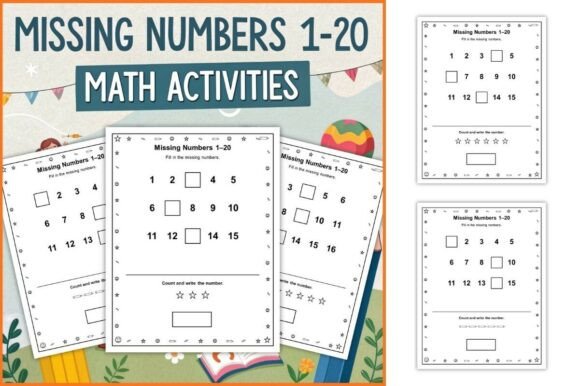
Designing Effective Missing Numbers 1–20 Worksheets
In the realm of educational graphic design, clarity is not just an aesthetic choice; it is a functional necessity. Missing Numbers 1–20 Worksheets represent a unique intersection where pedagogical utility meets visual communication. For designers creating resources for early learners, the challenge lies in balancing engagement with cognitive load. These worksheets are more than simple exercises; they are carefully structured visual tools designed to help young learners build strong number sense and counting skills through intuitive layout and typography.
The Role of Visual Hierarchy in Educational Design
When approaching the design of Missing Numbers 1–20 Worksheets, one must prioritize visual hierarchy. Young children are still developing their ability to scan and process information. A cluttered page can lead to confusion, whereas a clean, well-spaced layout guides the eye naturally from one task to the next. The primary goal is to support early learners as they develop confidence in working with numbers from 1 to 20 in a simple and visually clear format.
Effective use of white space is critical here. By allowing ample room around each number sequence, designers reduce visual noise, enabling the child to focus on the core task: recognizing number sequences and identifying missing numbers. This approach aligns with broader principles of UX design, where minimizing friction leads to better user outcomes. In this context, the "user" is a child, and the "outcome" is successful learning.
Typography and Readability for Early Learners
Typography plays a pivotal role in the success of these creative assets. Unlike corporate branding or editorial design, where stylistic flair might take precedence, educational materials require utmost legibility. When designing Missing Numbers 1–20 Worksheets, selecting a typeface that mimics standard handwriting conventions is essential. Sans-serif fonts with open forms are generally preferred because they are easier for children to decipher.
- Font Weight: Use medium to bold weights for instructions to distinguish them from the activity content.
- Letter-spacing: Increase tracking slightly to prevent characters from appearing crowded.
- Size: Ensure numbers are large enough to be easily traced or written over, supporting fine motor skills development.
These typographic choices directly impact the usability of the resource. A poorly chosen font can hinder number recognition, whereas a thoughtful selection enhances the learning experience. This attention to detail reflects the same rigor applied in professional logo design or packaging design, where every element serves a strategic purpose.
Integrating Visual Elements for Engagement
Beyond text, the integration of imagery and color transforms a static page into an interactive experience. The activities in these worksheets are created to encourage logical thinking by connecting counting with real-life objects. For graphic designers, this offers an opportunity to employ illustrative elements that reinforce the numerical concepts. For instance, pairing the number five with an illustration of five apples creates a dual-coding effect, strengthening memory retention.
Color palettes should be vibrant yet harmonious, avoiding overly saturated combinations that might cause visual fatigue. Consistency in color usage helps establish a brand identity for the educational series, making it recognizable and trustworthy for parents and educators. Whether used in classrooms, homeschooling, or extra practice at home, a cohesive visual style contributes to a professional presentation that appeals to adult buyers while engaging child users.
Technical Specifications and Print Design Considerations
From a production standpoint, ensuring high-quality output is non-negotiable. Designers must adhere to strict technical specifications to guarantee that the final product looks polished in both digital and print formats. Key considerations include:
- Page Size: Standard 8.5×11 inches ensures compatibility with home printers and school copiers.
- Resolution: High-quality print-ready files (300 DPI) prevent pixelation and ensure crisp lines.
- Format: Providing both PDF and JPG options increases versatility for different user needs.
- Bleed Settings: No bleed settings simplify the printing process for end-users who may not have professional equipment.
These technical details are part of a streamlined design workflow that prioritizes user convenience. By delivering a 21-page set that is ready to use, designers remove barriers to entry, allowing educators to focus on teaching rather than formatting.
Ultimately, the creation of Missing Numbers 1–20 Worksheets is a exercise in empathetic design. It requires understanding the cognitive limitations and capabilities of young learners while applying professional graphic design standards. By focusing on visual hierarchy, typography, and technical precision, designers can create resources that are not only educational but also visually appealing. This holistic approach ensures that every element, from the smallest numeral to the overall layout, contributes to a seamless and effective learning experience.